



Riflessioni sui Nostri Beati Martiri
5 novembre 2024
Solennità di San Guido M Conforti
Se il seme di frumento non finisce sottoterra e non muore, non porta frutto. Se muore, invece, porta molto frutto. Ve l’assicuro (Gv 12,24).
Cari confratelli,
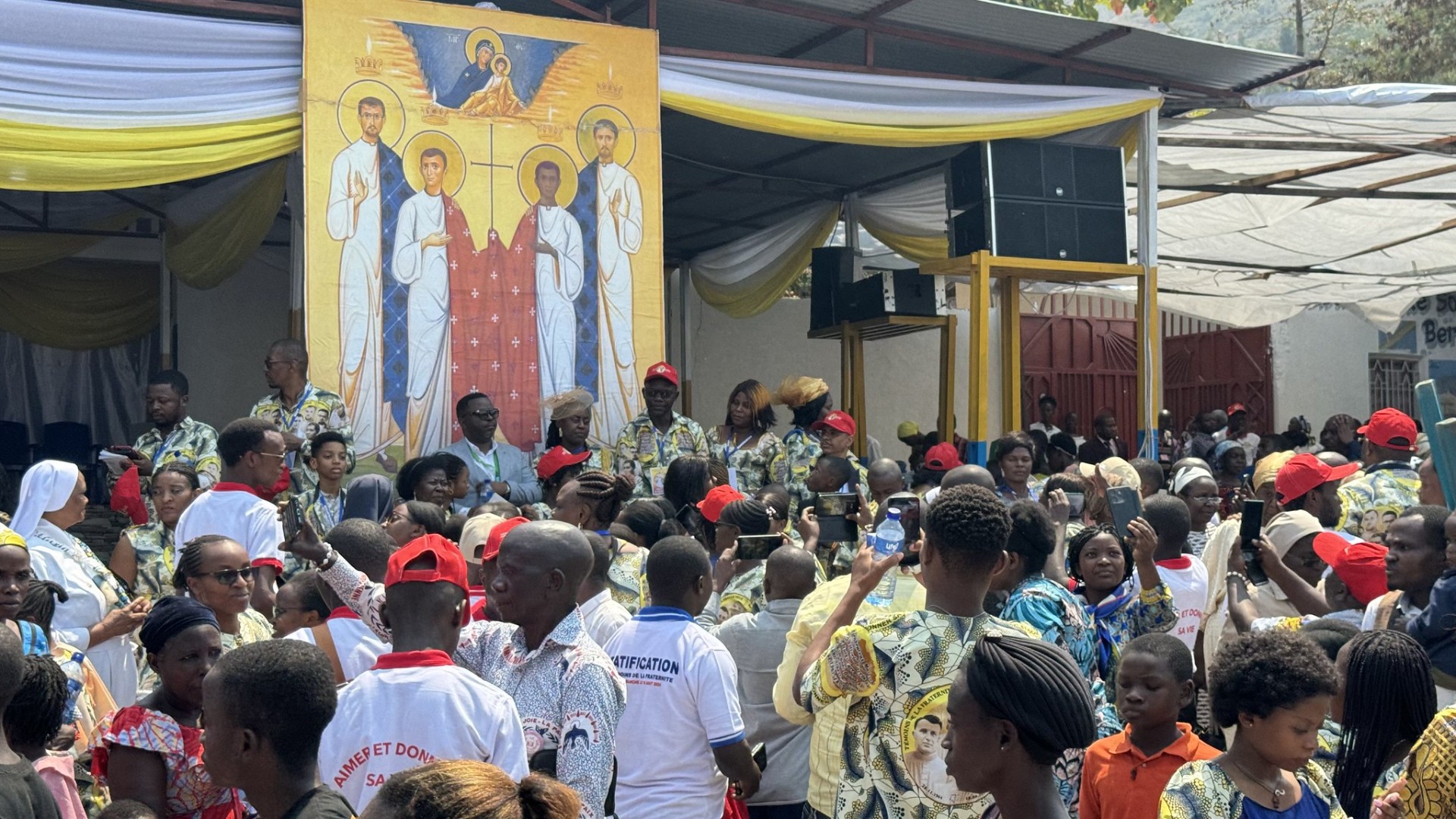
Il 18 agosto scorso la Chiesa ha proclamato beati i nostri confratelli Vittorio Faccin, Luigi Carrara, Giovanni Didonè e il sacerdote Albert Joubert. Riconoscendo la loro morte violenta come martirio in odium fidei, la Chiesa ha attestato che essi sono stati uccisi dando testimonianza dell'amore per Dio e per il popolo congolese che servivano.
Spontaneamente viene da chiedersi: da dove hanno tratto la forza per continuare a rimanere a Baraka e Fizi, sapendo che le loro vite erano in pericolo? Cosa li ha motivati a restare accanto al popolo congolese nonostante i pericoli, le minacce e le incertezze? Nei loro scritti, emerge con chiarezza la profonda spiritualità che li animava, la consapevolezza di essere strumenti nelle mani di Dio e la ferma volontà di seguire la Sua chiamata, qualunque ne fossero le conseguenze.
Con questa lettera, nella solennità di san Guido Maria Conforti, nostro Padre e Fondatore, vogliamo sottolineare tre elementi fondamentali che hanno caratterizzato la vita di questi nostri fratelli che la Chiesa ci propone come modelli di vita cristiana e saveriana. Lo facciamo con il desiderio che la testimonianza delle loro vite illumini e arricchisca le nostre.
Una vita di fede nel Dio rivelatoci da Gesù Cristo
Tutto inizia accogliendo la luce della fede nelle loro vite. Una fede trasmessa dalla famiglia e dalla comunità parrocchiale. È questa fede in Gesù Cristo e nel Dio rivelato nei Vangeli che, dall’inizio alla fine, ha guidato la vita di questi nostri fratelli. È la bellezza di questa fede cristiana, scoperta progressivamente nelle loro vite, che un giorno ha acceso in loro il desiderio di condividerla con coloro che non conoscevano ancora Gesù Cristo.
È questa fede che li ha fortificati e ha dato loro il coraggio di lasciare la famiglia, il proprio paese e di andare là dove c'era bisogno di apostoli del Vangelo. È questa fede che li ha guidati e condotti a chiedere al Superiore Generale di accettare l'offerta delle loro vite per amare e servire il Signore nel carisma saveriano. Ed è sempre questa fede che li ha sostenuti e animati nel momento della prova, fino a preferire la morte piuttosto che abbandonare la missione.
Una vita missionaria
La loro è stata una chiara chiamata ad essere missionari del Vangelo là dove il nostro Signore Gesù Cristo non era ancora conosciuto né amato. Si sono preparati per questo e quando è arrivato il momento tanto desiderato e sognato, hanno intrapreso il cammino verso la nuova destinazione con la piena fiducia che fosse il Signore ad inviarli.
Una volta arrivati in missione, hanno iniziato con impegno lo studio della lingua locale, aperti a quella nuova realtà che ora vedevano con i propri occhi e toccavano con le loro mani. Erano convinti che quella fosse la volontà d'amore di Dio per ciascuno di loro: amare e servire il Signore amando e servendo questo nuovo popolo che, col passare dei giorni e dei mesi, diventava progressivamente il loro stesso popolo.
La vita missionaria era per loro una scelta di vita totale. Non sono andati in missione per qualche anno pensando di tornare presto nel loro paese, erano lì con tutto: mente e cuore e non solo con il loro corpo. Sono partiti con l'idea di vivere per sempre con questo popolo, che non avevano scelto loro, ma che avevano accolto, attraverso la destinazione ricevuta, come il popolo che Dio gli stava donando.
Come missionari, hanno vissuto con intensità e profondità la relazione di alleanza che si è stabilita tra il popolo congolese e loro. È stata un'alleanza di vita, possiamo dire di eternità, condividendo con il popolo la vita quotidiana: gioie e tristezze, speranze e frustrazioni, illusioni e impotenze, paure e abbandoni, fino al punto culminante in cui hanno sentito che le loro vite erano intrecciate indissolubilmente con la vita di questo popolo. Hanno vissuto quindi quella comunione di vita e destino con i fratelli a cui siamo inviati fino al punto di condividere i loro problemi e il cammino di liberazione di cui parlano le nostre Costituzioni (C 14).
Per questo decisero di rimanere là dove il Signore era presente, incarnato in quelle persone e in quel popolo che erano diventati sangue del loro sangue e carne della loro carne.
Una vita saveriana
Vittorio, Luigi e Giovanni entrarono nell'Istituto Saveriano con il desiderio di essere missionari. Con gli anni della formazione chiarirono le loro motivazioni e consolidarono quella voce interiore che li accompagnava. Attraverso le diverse tappe formative videro sempre più chiaramente che il carisma saveriano era il segno dell'amore di Dio nelle loro vite.
Quando arrivò il momento di fare la professione perpetua, erano pienamente convinti che la vita saveriana fosse per l'eternità. C'era in loro un'unità fondamentale tra la vita di fede, la vita missionaria e la vita saveriana. Potremmo dire che la vita di fede e la vita missionaria si fondevano in un'unica realtà: la vita saveriana. Infatti, l'essere saveriano è un'identità propria nella Chiesa, dove le due realtà, fede in Gesù Cristo (C 3) e primo annuncio del Vangelo fuori dal proprio paese e cultura (C 9), sono intrinsecamente unite.
La vita saveriana, quindi, è stata la vita di questi nostri fratelli martiri. Vivere in questo modo, con questa convinzione, considerando anche la loro giovane età, non è stato qualcosa di naturale. Infatti, le cose serie non si improvvisano. La fedeltà con cui hanno vissuto la loro consacrazione fino a versare il loro sangue non è stato qualcosa di fortuito, bensì il risultato di un processo di formazione umana, cristiana e religiosa-missionaria, acquisita nel tempo e coltivata nella perseveranza quotidiana. Essa è iniziata nella loro famiglia d’origine, è proseguita nella vita cristiana parrocchiale, nella comunità formativa saveriana e si è conclusa con il loro martirio.
Che la testimonianza dei nostri beati martiri, in questo giorno in cui celebriamo la solennità di San Guido Maria Conforti, sia una luce permanente sul cammino delle nostre vite e diventi modello di vita umana, cristiana e saveriana.
I confratelli della DG
Reflections on Our Blessed Martyrs
November 5, 2024
Solemnity of St. Guido Maria Conforti
If the grain of wheat does not fall in the ground and dies, it does not bear fruit. If it dies, however, it bears much fruit. I assure you of this (Jn 12:24).
Dear Confreres,
On August 18, the Church proclaimed our confreres Vittorio Faccin, Luigi Carrara, Giovanni Didonè and the priest Albert Joubert Blessed. Recognizing their violent death as martyrdom in odium fidei, the Church has attested that they were killed bearing witness to their love for God and for the Congolese people they served.
Spontaneously, one wonders: where did they get the strength to continue to stay in Baraka and Fizi, knowing that their lives were in danger? What motivated them to stand by the Congolese people despite the dangers, threats and uncertainties? In their writings, the deep spirituality that animated them, the awareness that they were instruments in God's hands and the firm resolve to follow His call, whatever the consequences, emerges clearly.
With this letter, on the solemnity of St. Guido Maria Conforti, our Father and Founder, we want to emphasize three fundamental elements that characterized the life of these brothers of ours whom the Church proposes to us as models of Christian and Xaverian life. We do so with the desire that the witness of their lives will illuminate and enrich ours.
A life of faith in the God revealed to us by Jesus Christ
It all began by welcoming the light of faith into their lives. A faith transmitted by the family and the parish community. It is this faith in Jesus Christ and in the God revealed in the Gospels that, from beginning to end, has guided the lives of these brothers of ours. It is the beauty of this Christian faith, progressively discovered in their lives, that one day kindled in them the desire to share it with those who did not yet know Jesus Christ.
It is this faith that strengthened them and gave them the courage to leave their families, their country and go where apostles of the Gospel were needed. It is this faith that guided them and led them to ask the Superior General to accept the offer of their lives to love and serve the Lord in the Xaverian charism. And it is this faith too that sustained and animated them in the moment of trial, to the point of preferring death rather than abandoning the mission.
A missionary life
Theirs was a clear call to be missionaries of the Gospel where our Lord Jesus Christ was not yet known or loved. They prepared for this and when the so desired and dreamed of moment arrived, they embarked on the journey towards the new destination with full confidence that it was the Lord who was sending them.
Once they arrived at the mission, they began with commitment the study of the local language, open to that new reality that they now saw with their own eyes and touched with their hands. They were convinced that that was God's will of love for each of them: to love and serve the Lord by loving and serving this new people who, as the days and months passed, gradually became their own people.
Missionary life was a total life choice for them. They didn't go on a mission for a few years thinking they would soon return to their country; they were there with everything: mind and heart and not just with their bodies. They left with the idea of living forever with this people, whom they had not chosen, but whom they had welcomed, through the destination they had received, as the people that God was giving them.
As missionaries, they experienced with intensity and depth the covenant relationship that was established between the Congolese people and them. It was a covenant of life, we can say of eternity, sharing with the people daily life: joys and sadness, hopes and frustrations, illusions and helplessness, fears and abandonment, up to the culminating point when they felt that their lives were inextricably intertwined with the life of this people. They thus experienced that communion of life and destiny with the brothers to whom we are sent to the point of sharing their problems and the path of liberation of which our Constitutions speak (C 14).
This is why they decided to remain where the Lord was present, incarnated in those people and in that people who had become blood of their blood and flesh of their flesh.
A Xaverian life
Vittorio, Luigi and Giovanni joined the Xaverian Institute with the desire to be missionaries. Through the years of formation, they clarified their motivations and consolidated that inner voice that accompanied them. Through the different stages of formation, they saw more and more clearly that the Xaverian charism was the sign of God's love in their lives.
When the time came to make their perpetual profession, they were fully convinced that the Xaverian life was for eternity. There was a fundamental unity in them between the life of faith, the missionary life and the Xaverian life. We could say that the life of faith and missionary life merged into a single reality: the Xaverian life. In fact, being a Xaverian is an identity proper to the Church, where the two realities, faith in Jesus Christ (C 3) and the first proclamation of the Gospel outside one's own country and culture (C 9), are intrinsically united.
Xaverian life, then, has been the life of these martyred brothers of ours. Living in this way, with this conviction, even considering their young age, was not something natural. Indeed, serious things cannot be improvised. The faithfulness with which they lived their consecration to the point of shedding their blood was not something fortuitous, but the result of a process of human, Christian and religious-missionary formation, acquired over time and cultivated in daily perseverance. It began in their family of origin, continued in parish Christian life, in the Xaverian formation community and ended with their martyrdom.
May the witness of our Blessed Martyrs, on this day when we celebrate the Solemnity of St. Guido Maria Conforti, be a permanent light on the path of our lives and become a model of human, Christian and Xaverian life.
The confreres of DG
Solennité de Saint Guido M. Conforti
En vérité, en vérité, je vous le dis, si le grain de blé qui tombe en terre ne meurt pas, il reste seul ; si au contraire il meurt, il porte du fruit en abondance (Jn 12,24).
Le 18 août dernier, l’Église a proclamé bienheureux nos confrères Vittorio Faccin, Luigi Carrara, Giovanni Didonè et l’abbé Albert Joubert. En reconnaissant leur mort violente comme martyre in odium fidei, l’Eglise a attesté qu’ils ont été tués en témoignant de l’amour pour Dieu et pour le peuple congolais qu’ils servaient.
Du coup, on se demande : d’où ont-ils tiré la force de rester à Baraka et Fizi, sachant que leurs vies étaient en danger ? Qu’est-ce qui les a motivés à rester aux côtés du peuple congolais malgré les dangers, les menaces et les incertitudes ? Dans leurs écrits ressortent clairement la profonde spiritualité qui les animait, la conscience d’être des instruments entre les mains de Dieu et la ferme volonté de suivre son appel, quelles qu’en soient les conséquences.
Avec cette lettre, en la solennité de saint Guido Maria Conforti, notre Père et Fondateur, nous voulons souligner trois éléments fondamentaux qui ont caractérisé la vie de ces frères que l’Église nous propose comme modèles de vie chrétienne et xavérienne. Le souhait qui nous habite est de voir leurs vies illuminer et enrichir les nôtres.
Une vie de foi en Dieu révélé par Jésus-Christ
Tout commence par accueillir la lumière de la foi dans leur vie. Une foi transmise par la famille et la communauté paroissiale. C’est cette foi en Jésus-Christ et en Dieu révélé dans les Évangiles qui, du début à la fin, a guidé la vie de nos frères. C’est la beauté de cette foi chrétienne, découverte progressivement dans leurs vies, qui a un jour allumé en eux le désir d’aller et de partager avec ceux qui ne connaissaient pas encore Jésus-Christ.
C’est cette foi qui les a fortifiés et leur a donné le courage de quitter leur famille, leur pays et d’aller là où il y avait besoin des apôtres de l’Évangile. C’est cette foi qui les a guidés et conduits à demander au Supérieur général d’accepter l’offrande de leur vie pour aimer et servir le Seigneur dans le charisme xavérien. Et c’est toujours cette foi qui les a soutenus et animés au moment de l’épreuve, jusqu’à préférer la mort plutôt que d’abandonner la mission.
Une vie missionnaire
Pour eux, c’était clair qu’ils étaient appelés pour être des missionnaires de l’Évangile là où notre Seigneur Jésus-Christ n’était pas encore connu et aimé. Ils se sont préparés pour cela et quand le moment tant désiré est arrivé, ils ont entrepris leur chemin vers la nouvelle destination avec une confiance totale que c’était le Seigneur qui les envoyait.
Une fois arrivés en mission, ils ont commencé à étudier la langue locale avec un grand engagement, ouverts à cette nouvelle réalité qu’ils voyaient maintenant de leurs propres yeux et touchaient avec leurs mains. Ils étaient convaincus que telle était la volonté d’amour de Dieu pour chacun d’eux : aimer et servir le Seigneur en aimant et en servant ce nouveau peuple qui, au fil des jours et des mois, devenait progressivement leur propre peuple.
La vie missionnaire était pour eux un choix de vie total. Ils ne sont pas partis en mission pour quelques années avec l’intention de rentrer dans un bref délais dans leur pays, ils étaient là avec tout : esprit et cœur et non seulement avec leur corps. Ils sont partis avec l’idée de vivre pour toujours avec ce peuple qu’ils n’avaient pas choisi, mais qu’ils avaient accueilli, à travers la destination reçue, comme le peuple que Dieu leur donnait.
En tant que missionnaires, ils ont vécu avec intensité et profondeur la relation d’alliance qui s’est établie entre le peuple congolais et eux. Ce fut une alliance de vie, nous pouvons dire d’éternité, en partageant avec le peuple la vie quotidienne : joies et tristesses, espoirs et frustrations, illusions et impuissances, les peurs et les abandons, jusqu’au point culminant où ils ont senti que leurs vies étaient indissolublement liées à la vie de ce peuple. Ils ont donc vécu cette communion de vie et de destin avec les frères auxquels nous sommes envoyés jusqu’à partager leurs problèmes et le chemin de libération dont parlent nos Constitutions (C 14).
C’est pourquoi ils ont décidé de rester là où le Seigneur était présent, incarné dans ces personnes et ce peuple qui étaient devenus le sang de leur sang et la chair de leur chair.
Une vie xavérienne
Vittorio, Luigi et Giovanni sont entrés dans l’Institut xavérien avec le désir d’être missionnaires. Au cours des années de formation, ils clarifièrent leurs motivations et consolidèrent cette voix intérieure qui les accompagnait. A travers les différentes étapes de formation, ils ont vu toujours plus clairement que le charisme Xavérien était le signe de l’amour de Dieu dans leurs vies.
Quand le temps de la profession perpétuelle était venu, ils étaient pleinement convaincus que la vie xavérienne était pour l’éternité. Il y avait en eux une unité fondamentale entre la vie de foi, la vie missionnaire et la vie xavérienne. Nous pourrions dire que la vie de foi et la vie missionnaire se fondaient dans une seule réalité : la vie xavérienne. En effet, l’être xavérien est une identité propre dans l’Église, où les deux réalités, foi en Jésus-Christ (C 3) et première annonce de l’Évangile hors de son pays et de sa culture (C 9), sont intrinsèquement unies.
La vie xavérienne a donc été la vie de nos frères martyrs. Vivre ainsi, avec cette conviction, compte tenu de leur jeune âge, n’était pas naturel. En fait, les choses sérieuses ne sont pas improvisées. La fidélité avec laquelle ils ont vécu leur consécration jusqu’à verser leur sang n’a pas été fortuite, mais le résultat d’un processus de formation humaine, chrétienne et religieuse-missionnaire, acquise au fil du temps et cultivée dans la persévérance quotidienne. Elle a commencé dans leur famille d’origine, elle s’est poursuivie dans la vie chrétienne paroissiale, dans la communauté xavérienne de formation et elle s’est terminée par leur martyre.
Que le témoignage de nos bienheureux martyrs, en ce jour où nous célébrons la solennité de saint Guido Maria Conforti, soit une lumière permanente sur le chemin de notre vie et devienne un modèle de vie humaine, chrétienne et xavérienne.
Les confrères de la DG


