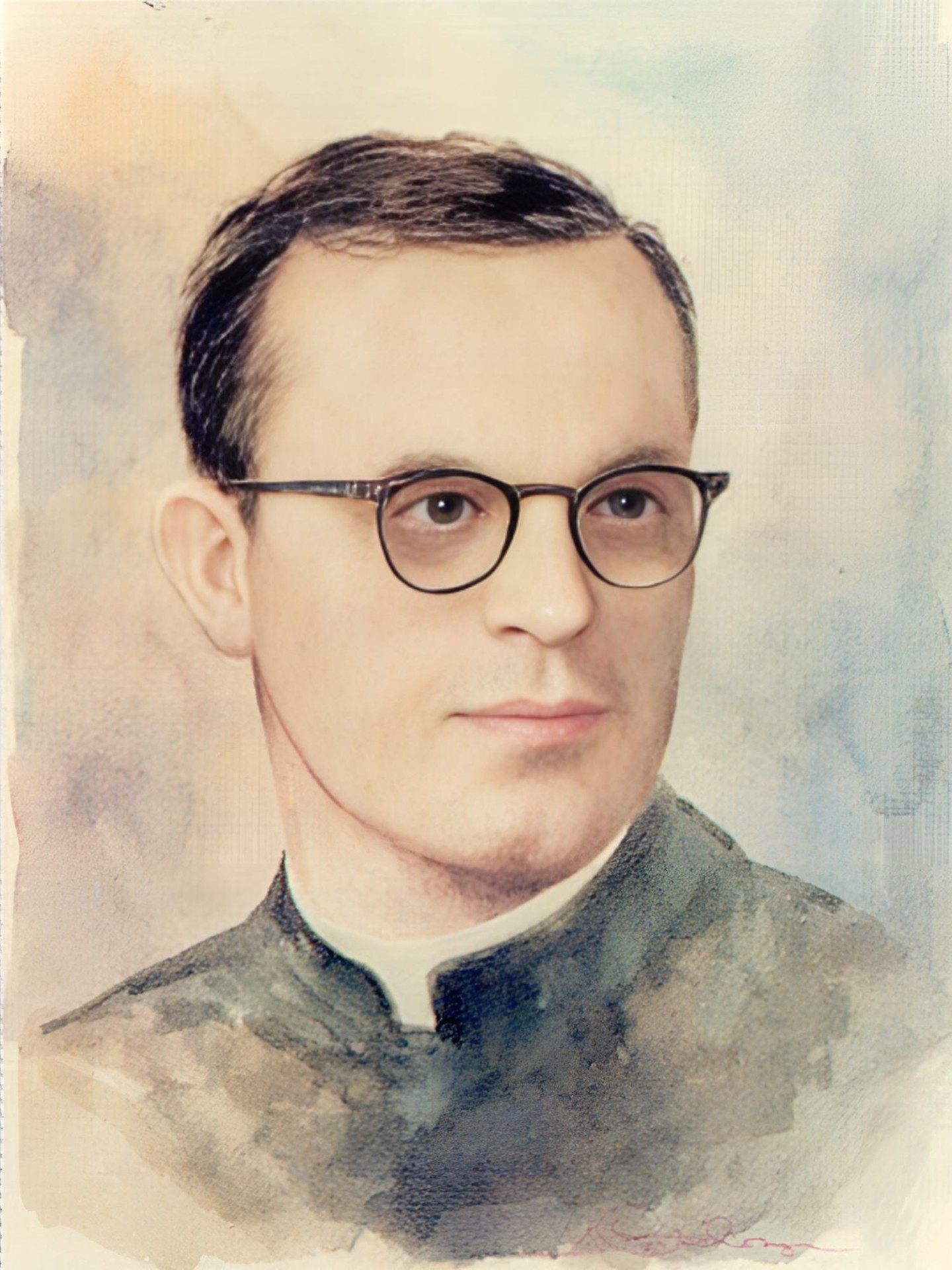


P. Valeriano Cobbe
Camisano (Vicenza), 14 Gennaio 1932
Jessore (Bangladesh),14 Ottobre 1974
Il P. Valeriano Cobbe, era nato a Camisano Vicentino (Vicenza) il 14 gennaio 1932 da Antonio e Scarmin Santa-Teresa ed aveva compiuto parte dei suoi studi in Italia, dove aveva emessa la sua prima professione il 12 settembre 1950, e parte in USA dove aveva fatto la sua professione perpetua il 5 novembre 1953 ed era stato ordinato presbitero il 2 febbraio 1957.
Rimase in USA, con vari compiti, fino al 1962 quando partì per il Bangladesh (3 ottobre 1962). Dopo quattro anni di pastorale fu destinato a Shimulia per collaborare con quel grande missionario che fu il P. Mario Veronesi. Il suo primo impatto con la realtà di quel villaggio, fatto in gran parte da ‘muci’, (gente considerata fuori casta), lo impressionò talmente che restò indeciso se restarvi o andare altrove. Decise di restare, convinto dall’esempio del P. Veronesi e dalla constatazione che la gente era buona, religiosa, timorata di Dio e c’era modo di riuscire a fare qualcosa.
Quel “qualcosa” si trasformò e si chiamò per lui: azione pastorale e sociale. Per quanto riguarda la prima, egli lavorò molto con i catechisti, il consiglio parrocchiale, i responsabili delle varie comunità dei villaggi, i maestri,... suscitando ovunque entusiasmo ed animazione.
Notevolissima fu l’attività sociale che lo impegnava per la maggior parte della giornata, ma era finalizzata chiaramente alla sua missione di annunziatore del Vangelo. Ne troviamo conferma in una sua in cui dice: “Alla base rimane sempre e solo un fatto: che siamo qui a predicare il messaggio evangelico, per ‘creare l’uomo perfetto nella misura che conviene alla piena maturità di Cristo’. Il contributo che il missionario dà allo sviluppo dei popoli è un’esigenza che scaturisce dal Vangelo. Gesù parlava alla gente, ma quando essa aveva fame, ne aveva compassione e le dava da mangiare. C’è inoltre da tener presente che in questo mondo dominato dal musulmanesimo l’unico messaggio cristiano che possiamo portare è quello del nostro esempio, del nostro lavoro sociale, della nostra carità umana e cristiana. Ogni altro messaggio verrebbe interpretato male, talora disprezzato e considerato contrario a queste tradizioni secolari. Ne ho già avuto la prova”.
Per tradurre questi princìpi in pratica, egli per prima cosa cercò di aiutare gli abitanti del villaggio a diventare comunità. Per questo organizzò una cooperativa agricola alla quale pian piano aderirono oltre duecento contadini. In secondo luogo con gli aiuti che riceveva dall’estero da amici, benefattori e da molte organizzazioni internazionali, riscattò tutti i terreni che le famiglie povere avevano dovuto dare come pegno per i prestiti ricevuti dagli usurai. In terzo luogo favorì la coltivazione del riso in modo che non solo bastasse per i bisogni familiari, me ne avanzasse per essere venduto fuori del paese. Per realizzare questo progetto riuscì a scavare sei grossi pozzi d’acqua che, forniti di pompe a motore, permettevano di irrigare circa ottanta ettari di risaia e di ottenere tre raccolti all’anno. Una cosa mai vista fino allora!
Il villaggio finì per essere chiamato “il villaggio d’oro” per il luccicare delle spighe. Naturalmente ciò richiedeva l’uso di trattori e di fertilizzanti, ma egli provvide sia gli uni che gli altri. Ogni membro della cooperativa pagava poi la sua quota di spese per carburante, concimi, sementi; lasciava una seconda quota per l’incremento della cooperativa e tratteneva il resto per sé.
P. Cobbe pensò anche all’istruzione scolastica e a tale scopo costruì un grande fabbricato ove i ragazzi e le ragazze del paese potevano iniziare i loro studi nelle elementari e portarli avanti fino alla fine delle medie.
Inoltre acquistò un appezzamento di terreno nella periferia del villaggio, lo divise in piccoli lotti, vi costruì una capanna per lotto e poi distribuì tutto ad una quarantina di famiglie nullatenenti in modo che ciascuna avesse la sua capanna ed il suo orticello. Vi piantò pure alcune pompe a mano per l’acqua e vi fece scavare un laghetto per l’immancabile bagno che i bengalesi fanno ogni giorno. A questo rione diede il nome di “Villaggio Papa Giovanni”.
Né il suo lavoro si fermò qui. Iniziò tre costruzioni in muratura: una per le suore, in sostituzione della precedente; la seconda per il centro di cucito e la terza per il consultorio della maternità. Né va dimenticata la carità usata per i poveri e soprattutto per i bambini. Per anni egli diede un pasto quotidiano ai bambini delle elementari provenienti dai villaggi vicini ove spesso non potevano avere non dico un pasto decente, ma nemmeno un pasto!
Il martirio
Questo complesso di opere di carità e di realizzazioni non poteva essere accettato da quanti vivevano sfruttando la miseria e lo stato servile della gente. Né questi potevano accettare che i ragazzi ‘fuori casta’ raggiungessero un grado di scolarizzazione simile a quella dei loro figli e tale da permettere loro di riscattarsi dal loro stato umiliante ed aspirare ad un giusto posto nella società. Ci furono dei segni evidenti e ripetuti di questa sorda opposizione ed il P. Cobbe li aveva capiti. Si può dire anzi che li aveva proprio presagiti la sera in cui venne ucciso: il 14 ottobre 1974.
Circa mezz’ora prima della sua uccisione, mentre si trovava dalle suore per prendere qualche medicina per sé, aveva detto ad una di loro: ‘Se mi uccidono, seppellitemi accanto al P. Veronesi’. Si fermò a parlare con le suore, poi si avviò verso la residenza. Verso le 9 di sera, mentre vi stava arrivando, alcuni sicari gli spararono a bruciapelo uccidendolo con un colpo al cuore, poi fuggirono nel buio.
Ora la sua salma riposa davanti alla chiesa del villaggio, accanto a quella del P. Veronesi suo maestro nell’esercitare la carità fino alla fine. “P. Cobbe, scrisse allora un suo confratello, ha voluto giocare d’azzardo con la storia e la società locale in nome dei valori umani e cristiani, ma la storia e la società hanno punito lui, bandiera degli oppressi levata troppo in alto: lui missionario e straniero. Questa sua fine insanguinata è l’atto supremo e conclusivo di otto anni di sforzi e di lavori per l’elevazione e lo sviluppo della sua comunità di “paria” oppressi. E’ la sua offerta finale: ‘Hoc est corpus meum; hic est sanguis meus‘”.
Fr. Valeriano Cobbe
Camisano (Vicenza), 14 Gennaio 1932
Jessore (Bangladesh),14 Ottobre 1974
Fr. Valerian Cobbe was killed killed at Shimulia, Bangladesh, on Oct. 14, 1974 at about 9:00 pm, as he was coming back from a visit to the sisters. Three loud shots shattered the stillness of the night. His close friend, Manuel Mistri, run to the rescue, and he was shot too. They laid dead in a pool of blood near the Xaverian residence, victims of assassin's bullets. He concerned himself with the social and economic welfare of the outcast of his own parish. He was 42 years old.
He was born on January 14, 1932, in Camisano Vicentino, in Northern Italy, son of Antonio and Teresa. In 1943, aged 11 years, he decided to enter the diocesan seminary. One day, a missionary arrived in Camisano. He preached, asked for prayers, financial help and vocations. Valerian Cobbe accepted the challenge: he would become a Xaverian missionary. On September 12, 1950, at the age of 18, he professed religious vows in the Xaverian Congregation. Two years later, in 1952, he sailed from Livorno with another four students on the ship “Maria Cristina” for the United States of America. With the support of Cardinal Richard Cushing of Boston, the Xaverians had decided to open a house there. That same year the Xaverian mission in East Pakistan was founded.
Valerian Cobbe was ordained priest on Feb. 2, 1957. He was appointed vice-rector and treasurer of the house in Petersham, USA. He helped out in the neighboring parishes, but his desire was to leave for the missions. On Oct. 2, 1957, he wrote to Father Giovanni Castelli, Superior General: “I have heard that we shall soon have a mission in the Belgian Congo. Please remember me when you are looking for priests to send there. I feel that my constitution is robust enough to withstand the rigors of the African climate. Above all, I feel an invincible desire to spend my life among those who do not yet know the Gospel, especially the poorest of the poor.” On Oct. 3, 1962, when he was 30 years old, he boarded a plane that would take him to Khulna, in East Pakistan.
After a year of language study, he was sent to Baniarchok, a village of fishermen, with Father Antonio Alberton, one of the pioneers of the Pakistan mission. After one year, Fr. Valerian was assigned to Khulna as administrator. In April 1964 Father Valerian Cobbe saw with his own eyes, for the first time, the devastation and desperation left by a cyclone that struck part of the mission: “Some villages have been literally wiped out and thousands are feared dead. The wind was so powerful that many dead people were found hanging from trees.”
After a brief period in Italy, Bishop Battaglierin welcomed him back to Pakistan with the news that he had been assigned to Shimulia with Father Veronesi. At the age of 35, he was to start a completely new adventure. Shimulia was not an easy assignment due to the great misery that reigned there. Nevertheless, Father Valerian Cobbe would rise to the challenge. Perhaps he felt impotent in the face of the misery, hunger, ignorance and natural disasters. The faith, love, help and advice of Father Veronesi helped him. He realized that something had to be done to help the people obtain food from the barren land. What they needed most were wells, and Father Cobbe set about finding ways to get them. In 1968, Father Mario Veronesi blessed the first well which provided water from 600 feet below the surface. A memorial stone bore the inscription “Isshorer dan”, which means “gift of God”.
Fr. Cobbe’s days were long: Mass, catechism, school, visits to the sick; a short break and then off to work in the fields. In the evening he joined in the community prayer in church, or said the rosary with some families, then more meetings. The day ended with a little reading, the accounts and correspondence. He sometimes retired to bed at 2 am, only to get up again shortly afterwards. He was getting thinner and in danger of falling sick, yet he walked barefoot in the mud during the rainy season. Father Cobbe taught his poor people that hard work was the best way to a dignified life. He led by his example. Fr. Silvano Garello wrote in his biography: “His poor people had become farmers thanks to the teachings of the experts who showed them how to cultivate rice and wheat. He worked with his people in the fields in order to share personally in their struggles. Now even the Hindus and the Muslims called him ‘Father’. A peaceful revolution was underway.” Father Cobbe commented: “It is almost a miracle to see Muslims, Christians and Hindus work in the same fields. Another amazing thing is that even the Christian women work in the fields: it is the first time in the history of this country that something of this nature has happened.”
On the night of Nov. 13, 1970, East Pakistan was hit by one of the worst cyclones in its history: 500,000 people died. Unfortunately, the country had to contend with another serious problem: the war of Independence of Bangladesh, which saw bloodshed. Father Mario Veronesi was among the victims of the war, killed by soldiers in Jessore on Palm Sunday, April 4, 1971. Father Cobbe, who had lived with him for more than four years, wrote to the Superior General: “I have cried so much that I now have an eye infection, but we press ahead with the harvest and the Holy Week celebrations. Father Mario was a giant among us, thanks to his spiritual stature and his charity.”
After a brief period in Italy, Fr. Cobbe is back to digging wells, building a school and huts for poor families, a house for the sisters and a welfare center. The voluntary organization “Mani Tese” sent one of its representatives, Aldo Bernabei, on a visit. He was impressed by what he saw: “Shimulia, which used to be a semi-deserted village, is now a flourishing center, thanks to the work of Father Valerian Cobbe. He has founded a cooperative of 215 peasants who look after about 150 acres of irrigated land with three harvests per year instead of the single meager harvest of previous years... it must be recognized that Father Cobbe’s work is both positive and profitable.”
He wanted progress, dignity and unity for his people. “All the Christians, Hindus and Muslims have been invited to participate in the agriculture project. It offers them the opportunity to pull down the longstanding barriers that divide them. In my eyes they are all equal; all of them, without distinction, are my parishioners.” He did not hesitate to stand up personally to the arrogant and high-handed people who oppressed the poor. Injustice made him indignant and he made enemies and once confided to a friend that some wanted him dead.
Father Valerian Cobbe was killed on October 14, 1974. He was 42 years old, 12 of which he had spent in the mission. That evening he went to greet the nuns, and he said to sister Rosaria: “If they kill me, please bury me next to Father Mario Veronesi.”