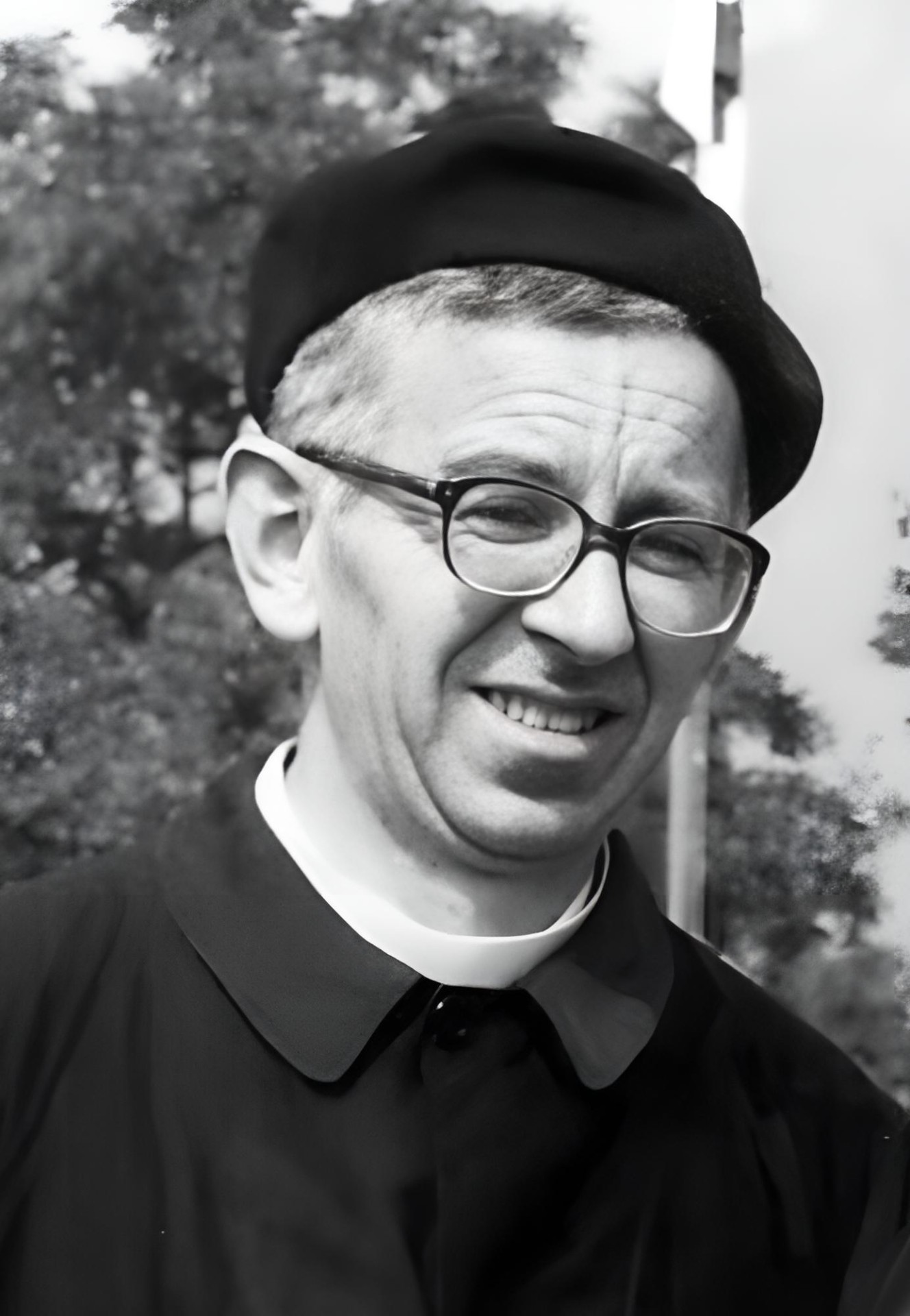


P. Aldo Marchiol
Udine - 12 Marzo1930
Buyengero (Burundi) - 30 settembre 1995
- Nasce ad Udine il 12 marzo 1930;
- Sacerdote saveriano dal 1958;
- Nel 1959 lo mandano a Massa Lucana, come padre spirituale di quella casa saveriana;
- Dal 1963, per sei anni, si sposta in varie case: Salerno, Parma, Udine, Cagliari, di nuovo la sua Udine;
- Dal 1969 torna a Salerno fino al 1978, quando, finalmente, andrà in missione, in Burundi.
- Nel 1987, a causa della persecuzione contro la Chiesa, deve lasciare il Burundi e tornare in Italia.
- Nel 1988 può ritornare in Burundi, che lascerà solo per un breve periodo di cure riposo, in Italia, nel 1994.
- Torna in Burundi a metà gennaio 1995, dove trova p. Maule e la volontaria Gubert, e dove la situazione è molto grave.
- Il 21 agosto 1995 a Bujumbura i Saveriani si riuniscono in assemblea per rispondere alla domanda: "Perché restare?"....
- Il 30 settembre, l'epilogo.
Un giorno come un altro nella tranquilla Buyengero. Ma la sera arrivano tre soldati.
Entrano nella casa dei padri. Prendono p. Marchiol, p. Maule e Catina Gubert, apostoli inermi del Vangelo, li fanno inginocchiare al centro della stanza più grande e li uccidono. Un colpo alla tempia per p. Maule, due per p. Marchiol, due per Catina.
Cadono insieme, nel loro sangue.
Credevano di umiliarli. Li hanno innalzati per sempre.
Fr. Aldo Marchiol
Udine - 12 Marzo1930
Buyengero (Burundi) - 30 settembre 1995
Fr. Aldo Marchiol (65 years old), Fr. Ottorino Maule (54) and Ms. Catina Gubert (75) were killed in the mission house with one gunshot in the head each at Buyengero, on Sept. 30 1995. The three missionaries who had worked many years in Burundi, were ordered to kneel down and then were executed. These missionaries received threats many times by the government army, for speaking on behalf of local people, and for the way army officers reported the killings in Burundi.
Aldo Marchiol was born in Udine (Northern Italy) on March 19, 1930. In his own words, he recalls the story of his vocation: “When I was a small boy, I was drawn by the idea of becoming a friar... As time passed, the idea lost its appeal and, when I was 17 years old, just as I was thinking about becoming an engineer, I was struck by some books I had read that belonged to my brother Bramante, who was then a seminarian. I began to think that I could perhaps express my love for God by becoming a priest, but then I shrugged that off too... In the Summer of 1947, I read two religious magazines that my brother brought home. It was then that I began to think seriously about becoming a missionary, but the decision process still proved to be painful: I was afraid of taking such a big step and, besides, I did not want to leave my school. Yet, the desire to be a missionary remained with me. Finally, one evening in September, I told my mother that I had made up my mind. I spoke about it with my parish priest and with Father Ulisse Benetti who was then the superior of the Xaverian house in Udine. He encouraged me and sent me to the house in Poggio San Marcello which was then the Xaverian seminary for second-career vocations.”
On October 11, 1950, he began novitiate, and made his first religious profession on October 12, 1951. He spent four more years studying in Desio, Milan until 1954, when he moved to Udine as assistant to the young students. In 1957, the theology student Aldo Marchiol was ordained a priest on Nov. 9 1958.
Many years later, during an interview, Father Aldo explained briefly why he had chosen to follow the missionary vocation: “I received a good Christian education from my family and parish; this, and the good example of my seminarian brother Bramante, attracted me to the priesthood. What I knew then of the missions and the Xaverians led me to choose this congregation... It was a real family atmosphere that encouraged us to pray, study and deepen our love and knowledge of the missions.”
After his ordination, he had to wait 20 years before receiving an assignment to direct missionary work.. He went to Massa Lucana (Salerno), to work as spiritual director. Father Agostino Clementini remembers his priestly devotion: “In addition to his well known simplicity, kindness, laboriousness, sincere and faithful friendship, and his fidelity to his duties (his breviary was always at hand), I remember the serene and silent way in which he endured his physical suffering. Father Marchiol would never have died in such a way if he hadn’t been prepared.”
He left Massa Lucana in 1963 and, in the next six years he moved around various houses: Salerno, Parma, Udine, Cagliari and, once again, back to his native Udine. The superiors tried to find the best place for his health, without much success: in spite of the different climates and treatment, his health did not improve. Yet, he never lost his smile. He went back to Salerno in 1969 and remained there for nine years until 1977 when, finally, he left for the missions. In the meantime, he was appointed confessor, mathematics teacher, and put in charge of contacts with the benefactors and the local page of the Xaverian Newsletter. He never explicitly asked to leave for the missions, fearful that his health would be an obstacle to himself and others. Only in 1975 did he express such a wish in a letter: “I pray that the Lord and my superiors will send me to the missions.”
Notwithstanding his 47 years, he learns Kirundi in Burundi, a difficult language, as he writes to the Superior General in March 1977, and starts his ministry first at Bujumbura, and then at Butara. This was a difficult period (1982-83) that saw the first expulsion of Xaverians from Burundi. President Bagaza is in power, who leans towards communism and does not tolerate any criticism on his antichurch propaganda. Fr. Aldo remains in Burundi, nonetheless, helping at Gasorwe and Gisanze.
He suffers the contradictions which he encounters on his service; he wrote to the General Superior on March 18 1987: “I may be too pessimistic, but the priests do not even have the courage to pray in their assemblies for their brother priests who are in prison. This is true paganism. We missionaries should be stirring up within them true Christian sentiments, but there are not many of us left and we do not count very much anyway. I am saddened more by the passive acceptance of the persecution than by the persecution itself. This is a suicidal gesture. We will press ahead in Burundi, but who knows for how long. On the other hand, it may be no bad thing for this Church to experience persecution: its faith and commitment will be put to the test, and its pastors and faithful will have to waken up and become more aware of their Christian identity. I think we are reaching the stage when we will have to decide whether or not to remain here. I suffer whenever I hear priests say that it is enough to be Christians and that we don’t have to be part of the hierarchical Church; it is enough that we do as much good as possible. Everyone commands in this Church except the bishops. At the end of January, hostile excerpts from a little green book were read out in churches throughout the entire country; in some cases, it was read out by catechists and some mayors during Mass. Confusion reigns! Yet the bishops tell us not to speak out. How are we to defend the flock of Christ? Some missionaries steer a middle course and do everything they can to remain at all costs. This is not the correct way of going about things!”
After one month, he is expelled from Burundi, together with many other religious missionaries. After a brief period in Italy, he returns to Burundi in October 1988, and serves first at Ruzo, then Bujumbura, and finally at Buyengero (at the beginning of 1995), till the day of his martyrdom.
Those who saw him at work in that period remember how he distinguished himself for his kindness and patience and his calm way of going about his duties. His was a demanding job: he had to provide for the hospitality of Xaverians, members of other religious congregations and, during the height of the troubles, look after the journalists who had come to cover the events in nearby Rwanda. He was liked and appreciated by everyone who came into contact with him. One of them recalls him saying: “We need to continue in the work of peace and reconciliation… Who can wash away this blood? How am I able to give absolution to assassins?” (Renata Pisu, in La Repubblica, Oct. 2 1995).
And again, in a phone call to his brother Fr. Bramante, of the Missionary Oblates of Immaculate Mary, he said: “If they decide to attack foreigners, the Xaverians will be the first to be killed.” Nevertheless, he continued his work with Father Maule. They went out like the apostles, who were sent by Jesus two by two to preach the Good News in the villages of Palestine. They set out, armed only with the faith.
Finally, the image of this Xaverian martyr would not be complete if we did not mention two aspects of his life. He was faithful to the prayer of the Breviary and on the meditation of the Word, morning and evening. And often he ended the day with the Rosary.
He is also remembered as a man of few words, notwithstanding his acute observation of people and situations. He became indignant at the many injustices that tormented Burundi. He got involved in heated discussions about the situation, making a critical analysis and suggesting solutions without ever falling victim to defeatism. He also stood out for his profound spirit of prayer and, though he never really achieved a good grasp of the local language, he won people over by his kindness. Some remember him as a saint.
May he rest in Peace!